| Material | Stainless Steel 316Ti (1.4571) or Hastelloy C-22 (2.4602) |
|---|---|
| Temperature max. | 230° C |
| Pressure max. | 200 bar |
| Reactor vessel Volume | approx. 250 ml |
| Reactor vessel Inner Diameter | 44 mm |
| Reactor Vessel Inner Height | 166.7 mm |
| Reactor Vessel weight | approx. 2.1 kg |
| Volume | approx. 195 ml |
| Inner diameter | 40 mm |
| Inner height | 158.7 mm |
| Standard armatures | Rupture Disc, Dip Tube, Valve |
| Pressure Measurement | analog and/or digital |
| Ports (total) | 5 |
| Type of connection | 8 mm Tube Connection |
| Heating Systems (optional) | Electrical (Hot Plate) |
| Stirring | Via Hot Plate |


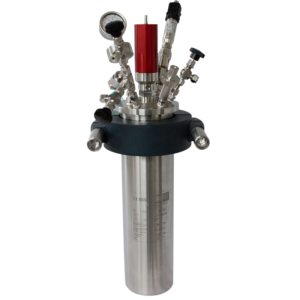
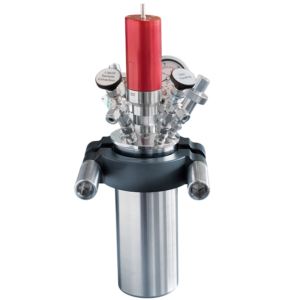
Berghof High Pressure Reactor (BR-200)
The high-pressure reactors BR-100 and BR-200 are the bestsellers amongst the Berghof reactors. The application range for these reactors is very large, though they are used often for synthesis and catalyst researches. BR-100 and BR-200 reactors are made of stainless steel or hastelloy. Furthermore, depending on the configuration of the vessels, they can be used with PTFE inserts.
The BR-100 and BR-200 high-pressure reactors are suited perfectly for first step experiments in a regulated environment. The modular design of the reactors allows the use of one lid for all four vessel options of the two reactor series.
The standard equipment of the BR-100 and BR-200 reactors consists of the following components:
- Rupture disc, valve and dip tube
- Device for pressure measurement (analog and/or digital)
- Five ports (8 mm tube connection). One port is free for individual use. By the use of T-connections, the number of free ports can be enlarged
The inner volume of the reactor vessels varies from 75 ml to 250 ml. The whole reactors, also the armatures and the lid, are made of stainless steel 316 Ti (1.4571) or hastelloy C-22 (2.4602). The total weight of the BR-100 reactors is approx. 1.8 kg, the total weight of the BR-200 reactors is approx. 2.1 kg. Therefore, the reactors can be moved easily within the lab. By the use of magnetic stirring rods, experiments that require stirring, can be carried out, too.
Typical applications for the BR-100 and the BR-200 high-pressure reactors are synthesis, such as hydrogenations, as well as simple catalysts researches, such as tests of catalysts consisting of liquid or solid materials.